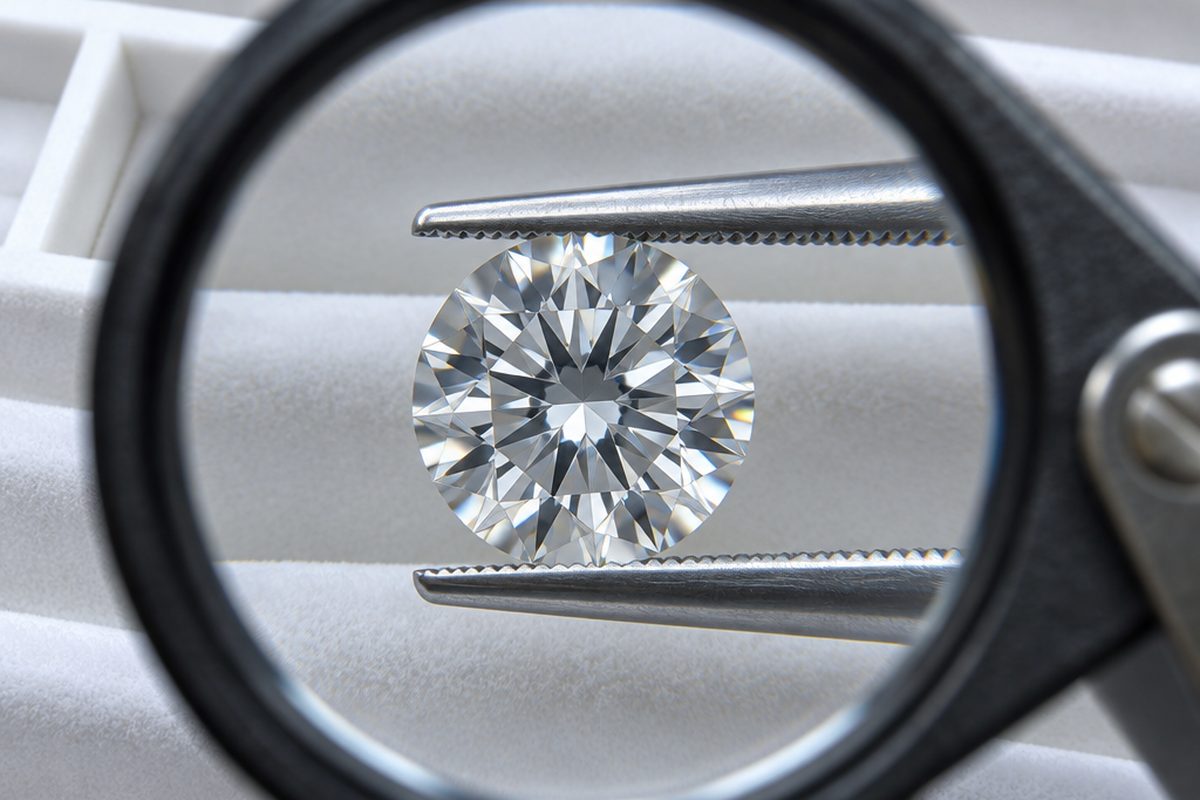
Clarity describes the tiny marks inside a diamond, called inclusions, and on its surface, called blemishes. GIA grades clarity on 11 steps from Flawless (FL) to Included (I3), judged under 10x magnification. Many diamonds sold in jewellery stores are VS or SI, and plenty of those look clean to the naked eye.
What clarity means
Almost every diamond has small features that formed as it grew deep in the earth, or that were left during cutting and wear. Those inside the stone are inclusions, and those on the surface are blemishes. Clarity grading describes how many there are, how large they are, where they sit and how easy they are to see.
The GIA clarity scale
The Gemological Institute of America (GIA) scale has six categories and 11 grades. A trained grader judges each diamond under 10x magnification.
| Grade | Name | What a grader sees at 10x |
|---|---|---|
| FL | Flawless | No inclusions or blemishes |
| IF | Internally flawless | No inclusions, only minor surface blemishes |
| VVS1, VVS2 | Very, very slightly included | Minute inclusions that are difficult for a skilled grader to see |
| VS1, VS2 | Very slightly included | Minor inclusions, seen with effort |
| SI1, SI2 | Slightly included | Noticeable inclusions, easy to see at 10x |
| I1, I2, I3 | Included | Obvious inclusions, which may be visible without magnification |
Which grades look clean to the eye
Clarity grades describe what is seen under magnification, not what you see on the hand. Many VS diamonds, and plenty of SI diamonds, show nothing to the naked eye. Whether a particular stone looks clean depends on the size of the inclusions, where they sit and the size and shape of the diamond.
An inclusion near the edge of the stone can often be hidden under a claw. One in the middle of the top of the stone is the hardest to hide.
Clarity and diamond shape
Brilliant shapes such as round, oval and cushion have many facets that break up light, which helps hide small inclusions. Emerald and other step cuts have long, open facets that show more of the inside of the stone, so clarity matters more. Our guide to diamond shapes compares each one.
Clarity alongside colour, cut and carat
Clarity is one of the four Cs, with colour, cut and carat weight. Each changes the look and the price, and where you spend depends on what matters to you. Read our diamond colour chart next, and see how to set a ring budget.
See stones in person
Two stones with the same grade can look different, so it pays to see them side by side. Visit us at 378 Chapel Street, South Yarra, or tell us what you are after in our ring designer.
Questions
What is the best clarity grade for an engagement ring?
Many people look for a stone that is clean to the eye, which can be a VS or SI grade depending on the stone, and spend the difference on size or colour.
Is VS1 or VS2 better?
VS1 is a higher grade than VS2. Both usually look clean to the naked eye.
Can you see inclusions in an SI diamond?
Sometimes. Many SI stones look clean without magnification, and others show inclusions. It depends on the stone.
Do lab-grown diamonds have clarity grades?
Yes. Laboratory-grown diamonds are graded on the same clarity scale.
Can clarity be improved?
Some diamonds are treated to make inclusions less visible. A treatment should always be disclosed to you.