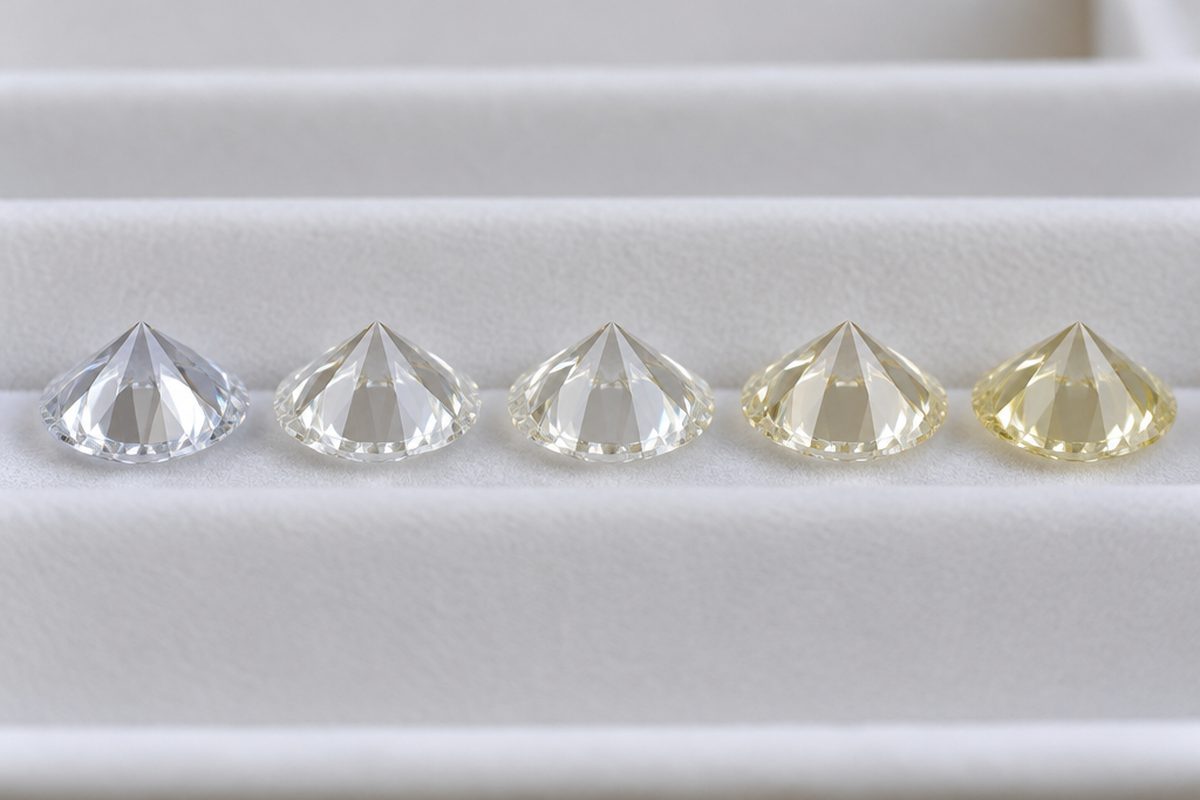
Diamond colour is graded on the GIA scale from D, which is colourless, to Z, which has a light yellow or brown tint. The grades fall into five groups. D to F are colourless, G to J are near colourless and usually look white once set, and from K onwards the warmth becomes easier to see.
What colour means in a diamond
Most white diamonds have a trace of yellow or brown. Colour grading measures how little there is. The less colour a diamond has, the higher its grade and the rarer it is. Pink, blue and other fancy coloured diamonds are graded on a separate system.
The GIA colour scale
GIA's scale runs from D to Z. It starts at D because its creators wanted a fresh start, free of the older A, AA and AAA systems.
| Grades | Group | How it looks |
|---|---|---|
| D, E, F | Colourless | No colour seen by eye. The differences show only to a trained grader using master stones |
| G, H, I, J | Near colourless | Colour is hard to see except by a trained grader, and usually looks white once set |
| K, L, M | Faint | A faint warmth that can be seen |
| N to R | Very light | Light yellow or brown that is easy to see |
| S to Z | Light | A clear yellow or brown tint |
How colour is graded
A grader places the diamond upside down on a white tray and compares it with a set of master stones of known colour, under controlled light. Looking at it from underneath hides the sparkle, which would otherwise make colour hard to judge.
Colour and the metal you choose
The metal around a diamond changes how its colour looks. White gold and platinum sit beside the stone without adding warmth, so a white metal shows any tint more clearly. Yellow and rose gold are warm themselves, so a near colourless or faint stone can look at home in them.
If you love yellow gold, you may not need the top colour grades. A stone in the near colourless range set in yellow gold can look white on the hand. See 9ct or 18ct gold and white gold or platinum.
Colour, shape and size
Colour is easier to see in larger stones, and in some shapes. Brilliant cut rounds hide colour well, while shapes such as emerald cuts and ovals can show more of it, especially at the ends. Our guide to diamond shapes goes through each one.
Balancing colour with the other Cs
Colour sits alongside clarity, cut and carat weight. Choosing a near colourless grade over a colourless one can free up budget for size or clarity. Read our diamond clarity chart, then see the stones in person at 378 Chapel Street, South Yarra.
Questions
What is the best diamond colour for an engagement ring?
It depends on the metal and your eye. Many people choose a near colourless stone, G to J, which looks white once set and costs less than D to F.
Is an H colour diamond good?
H is in the near colourless range, so its colour is hard to see without comparing it to other stones.
Why does a diamond look different in yellow gold?
Yellow gold is warm, so it makes any warmth in the stone less noticeable than white metal does.
Are yellow diamonds graded on the same scale?
Diamonds with strong colour beyond Z are graded as fancy colour diamonds, on a separate system.