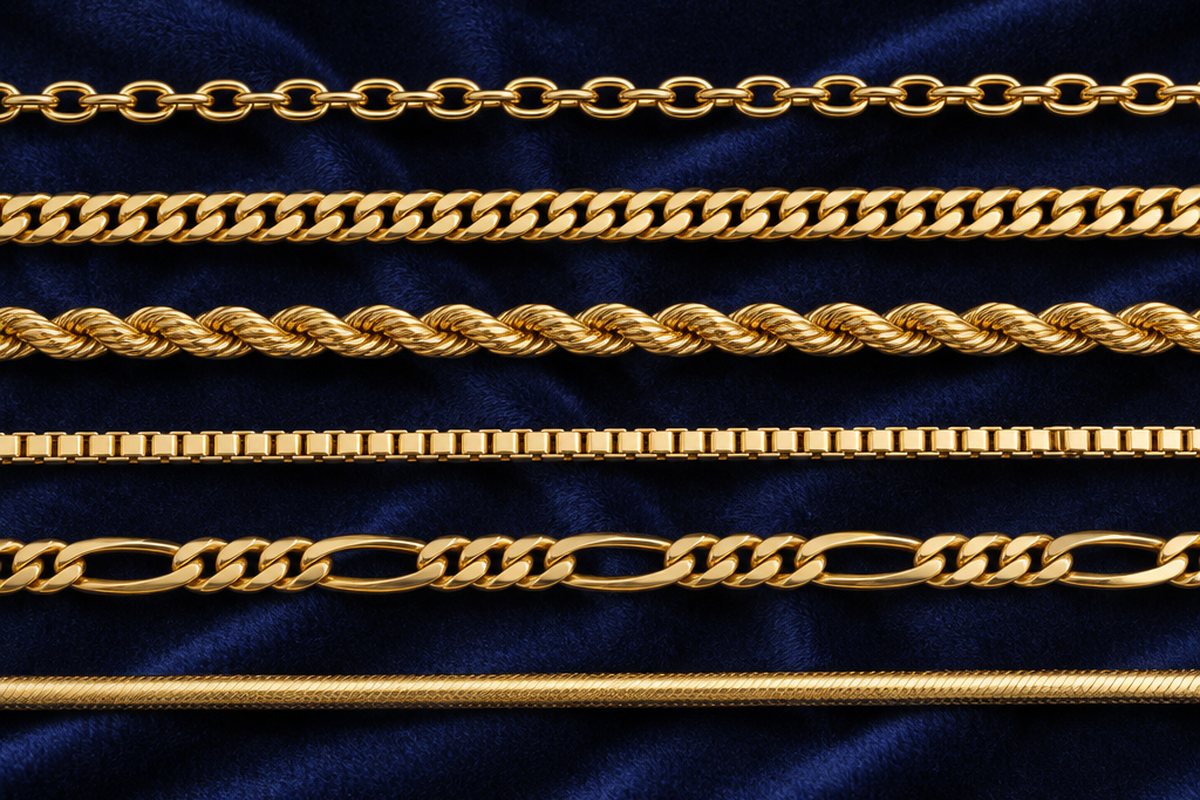
A chain is named for the shape of its links. Cable and belcher chains have simple round or oval links, curb chains have flattened twisted links, rope chains twist like rope, and box, snake and herringbone chains are smooth and close-linked. For a pendant, choose a chain strong enough to carry it and with a bail it can pass through.
Common types of chain
| Chain | What the links look like |
|---|---|
| Cable | Plain oval or round links joined one through the next |
| Belcher | A cable chain with rounder, wider links |
| Curb | Links twisted so they lie flat when the chain is laid down |
| Figaro | A pattern of short links and one longer link, repeated |
| Rope | Small links joined to twist around each other, like rope |
| Box | Square links joined to make a smooth, square chain |
| Snake | Close joined plates that make a smooth, flexible tube |
| Herringbone | Flat, slanted links that lie like a ribbon |
| Wheat | Twisted oval links that look like an ear of wheat |
| Paperclip | Long, flat oval links shaped like paperclips |
Chains for everyday wear
Cable, belcher, curb and rope chains are strong for their weight and flexible, so they suit everyday wear and sit well under clothes. Wheat chains are also hard-wearing and keep their shape.
Box chains are sturdy for a fine chain and suit small pendants. Figaro and paperclip chains are often worn on their own as a feature.
Chains that need more care
Herringbone and snake chains are smooth and catch the light, but their flat, close links can kink if they are bent sharply or knotted. A kink in a herringbone chain is hard to fix.
Lay herringbone and snake chains flat or hang them up when you take them off. Don't wrap them around your fingers or store them in a tangle.
Choosing a chain for a pendant
- Check the bail, the loop at the top of the pendant, is big enough for the chain and its clasp to pass through.
- Choose a chain strong enough for the pendant. A heavy pendant on a very fine chain wears the links and can stretch or break them.
- Cable, belcher, box, rope and wheat chains hold a pendant well.
- Herringbone and snake chains are better worn on their own, without a pendant.
Chain lengths
| Length | Where it usually sits |
|---|---|
| 40 cm | Close to the base of the neck |
| 45 cm | At the collarbone, a common length for pendants |
| 50 cm | Just below the collarbone |
| 55 to 60 cm | Below the collarbone, often worn over clothes |
Where a chain sits depends on the size of your neck, so measure a chain you already wear if you can.
Chains in store and repairs
We carry gold chains in store. See the collection or visit us at 378 Chapel Street, South Yarra to try lengths and styles. If a chain has a kink or a broken clasp, see jewellery repairs. For which gold to choose, see 9ct or 18ct gold.
Questions
Which chains are hard-wearing?
Curb, cable, belcher, rope and wheat chains wear well. A thicker chain is stronger than a fine one of the same style.
Which chains suit a pendant?
A cable, belcher, box, rope or wheat chain strong enough for the pendant, with links that fit through the bail.
Why does my snake chain have a kink?
Snake and herringbone chains kink when they are bent sharply or knotted. Store them flat or hanging.
What length chain should I get?
45 cm is a common length for a pendant. Measure a chain you already wear to see where it sits on you.
Can a broken chain be repaired?
Often, yes. Bring it in or send a photo. See jewellery repairs.